

contact@govacons.com.vn

0938 727 179



A commercial operating date is not the last line of a construction programme. It may be the date a plant must make its first saleable output, support a customer commitment, or transfer activity from another location. On that date, a building may be weather-tight while the line cannot run; equipment may be in place while power, water, compressed air, operating data, or people are not ready. Treating “construction complete” as the operating date creates a reassuring schedule that does not answer the business question: when can the operation genuinely create value?
The target date is not a reason to waive legal or technical conditions. It is a planning input that exposes sequence and decision deadlines. An owner does not need to become a construction specialist. The owner needs choices, required decisions, limits, dependencies, and evidence made visible; advisers and delivery teams must turn that information into a route that can be tested rather than merely promised.
Backward planning begins by defining what “operational” means in observable terms: no-load running, running with material, achieving an agreed output, or being ready to serve customers. Each definition needs different evidence. The team can then work backwards through production preparation, commissioning and checks where applicable, completion and handover, utilities, equipment installation, envelope, structure and foundations, then technology data, surveys, design and legal inputs.
A credible programme gives every link an entry condition, an exit condition, an owner and evidence. The critical path is not necessarily the largest package. A machine load, pit location, connection level or supplier lead time can block several teams. The plan should reveal what can be prepared, what must wait, and the latest answer date that protects the target.
Where the target date is flexible, the practical value is often in testing options and avoiding early commitments to unclear scope. Where the date is fixed and inputs arrive early, packages can be organised around clear interfaces, while still separating confirmed information from planning assumptions.
The difficult profile is a fixed date with late inputs: equipment interfaces remain open, site conditions are unresolved, or operating scope changes. There is no honest template response. The project needs options: protect the date through a split scope, alter the sequence of use, or revise business assumptions. Each option must state continuing work, deliberate holds, required evidence and the consequence of late decisions.
For a specific project, the legal route should be reviewed against location, use, scale, land status, infrastructure and filing date. Instead of reporting that “legal work is under way”, build a matrix of the procedure or dossier under review, missing inputs, design dependencies, document owner and affected milestones. This gives the owner decisions rather than a vague status update.
Published information on Government Resolution 66.18/2026/NQ-CP, issued on 18 May 2026 and effective from 1 July 2026, states a 10-working-day period for building-permit issuance and a 9-working-day period for permit adjustment, counted from receipt of a complete valid dossier. That statutory period starts only after a complete valid dossier; project-specific applicability still depends on actual facts and filing date.
Parallel preparation may be appropriate where work is lawful, independent and supported by the necessary inputs. It never means bypassing conditions or filing on an unsupported basis. Every assumption should have an owner, evidence requirement and decision point.
A drawing is not automatically a procurement basis merely because it has an issue date. Before release, the team should distinguish confirmed data, open interfaces and the consequences of change after order. Preliminary figures may help a layout, but they should not silently become a construction commitment for foundations, supports, technical routes or equipment access.
Early packages should be genuinely independent: additional survey, site preparation, structure outside open interfaces, or long-lead items whose specification is stable. Work directly tied to final machine dimensions, loads, anchors, maintenance clearance or utility demand needs a clear lock point. Holding only the unresolved portion protects completed work from demolition.

Long-lead procurement belongs on the same decision calendar as design. Required order date, data due to the supplier, sample approvals, manufacture, transport, incoming checks and site access must be visible together. Options should be compared by interface impact, change exposure and evidence, not price alone.
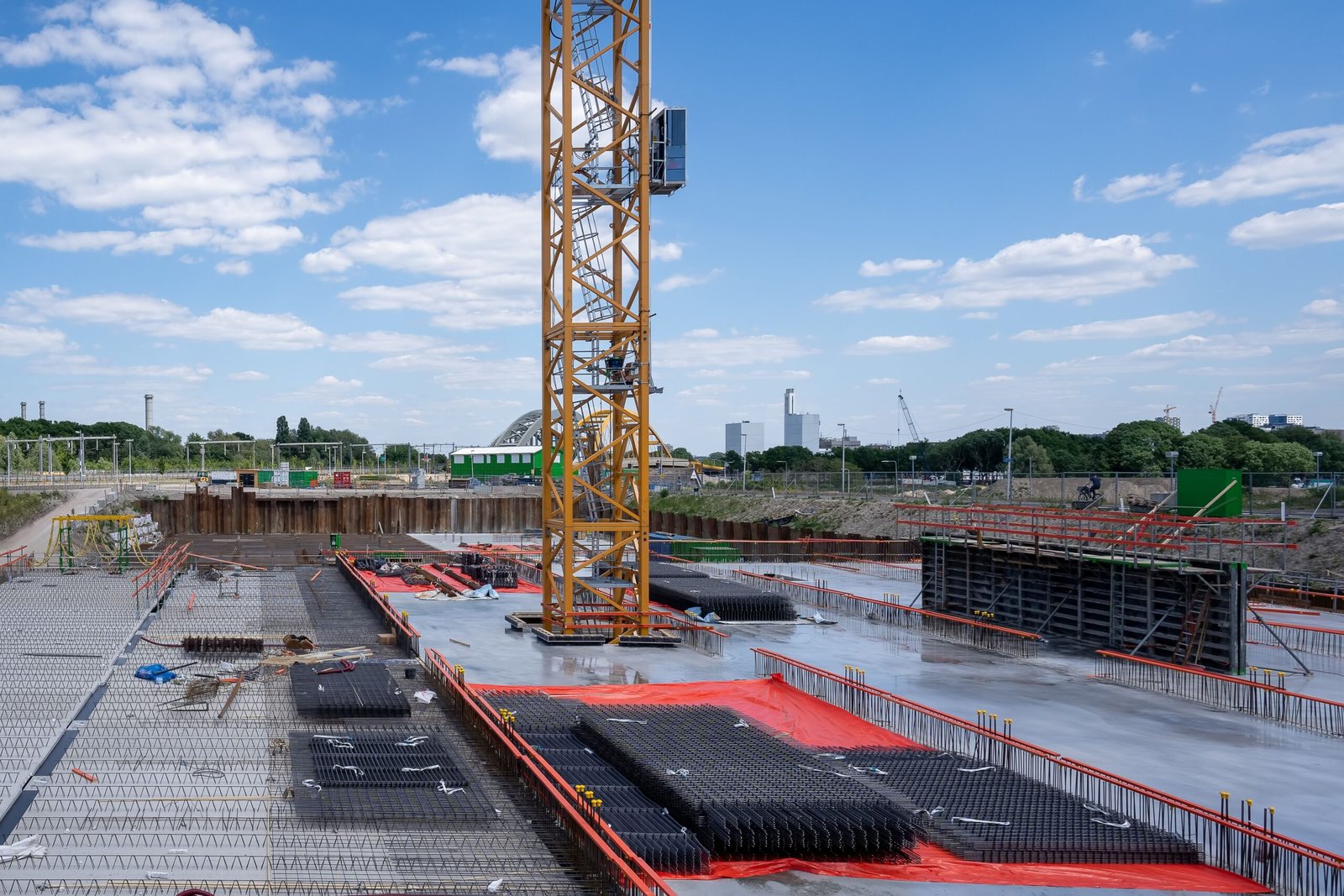
A site is not ready because equipment has reached the gate. Boundaries, levels, access, temporary drainage, storage, temporary utilities, lifting space and neighbouring operational constraints should be checked as mobilisation conditions. A method and resource plan should identify team, method, area and inspection point before work is concealed.

Sectional handover can create more value than waiting for the whole building, but only with a clear boundary and completion criteria. An equipment area needs the required access, slab, structure, supply, protection and coordination route. Otherwise “partial handover” transfers an incomplete space and missing work returns later as an emergency.
Contingency is not a hidden number of days at the end. It should be allocated against a named uncertainty—weather, ground, interfaces, supply, procedures or change—and have an escalation owner and trigger.
For each milestone, record the result required, the document or observation that proves it, the confirming party and the condition it opens for the next activity. This prevents a milestone from being reported complete simply because one team has finished its isolated task. It distinguishes activity from readiness.
A short decision register maintained consistently is often more valuable than a very detailed master schedule nobody uses. Record the fact, assumption, options, decision owner, response date and effect of no answer. When information changes, the team can trace where an earlier assumption was used before continuing.
Ask suppliers for checkable interface data rather than a general request for drawings: loads, dimensions, working clearance, connection points, installation route and maintenance limitations. Clear requests reduce loops and separate data usable now from data that remains illustrative.
Not every change deserves the same route. A change affecting structure, slab, safety, utilities or dossier conditions needs assessment before instruction. Low-impact finish choices can have a lighter path. This keeps attention on decisions capable of breaking the critical path.
Operating preparation needs its own owner, not a late appendix to construction. Training, staffing, trial material, industrial cleaning, quality procedures and handover-data reception should develop against appropriate milestones. Otherwise the building may be complete while the business still cannot start.
Report language should expose confidence: confirmed, awaiting confirmation and assumed for planning are not interchangeable. Accurate labels prevent a planning premise becoming an undeclared commitment and enable disciplined contingency.
For each milestone, record the result required, the document or observation that proves it, the confirming party and the condition it opens for the next activity. This prevents a milestone from being reported complete simply because one team has finished its isolated task. It distinguishes activity from readiness.
A short decision register maintained consistently is often more valuable than a very detailed master schedule nobody uses. Record the fact, assumption, options, decision owner, response date and effect of no answer. When information changes, the team can trace where an earlier assumption was used before continuing.
Ask suppliers for checkable interface data rather than a general request for drawings: loads, dimensions, working clearance, connection points, installation route and maintenance limitations. Clear requests reduce loops and separate data usable now from data that remains illustrative.
Not every change deserves the same route. A change affecting structure, slab, safety, utilities or dossier conditions needs assessment before instruction. Low-impact finish choices can have a lighter path. This keeps attention on decisions capable of breaking the critical path.
Operating preparation needs its own owner, not a late appendix to construction. Training, staffing, trial material, industrial cleaning, quality procedures and handover-data reception should develop against appropriate milestones. Otherwise the building may be complete while the business still cannot start.
Report language should expose confidence: confirmed, awaiting confirmation and assumed for planning are not interchangeable. Accurate labels prevent a planning premise becoming an undeclared commitment and enable disciplined contingency.
For each milestone, record the result required, the document or observation that proves it, the confirming party and the condition it opens for the next activity. This prevents a milestone from being reported complete simply because one team has finished its isolated task. It distinguishes activity from readiness.
A short decision register maintained consistently is often more valuable than a very detailed master schedule nobody uses. Record the fact, assumption, options, decision owner, response date and effect of no answer. When information changes, the team can trace where an earlier assumption was used before continuing.
Ask suppliers for checkable interface data rather than a general request for drawings: loads, dimensions, working clearance, connection points, installation route and maintenance limitations. Clear requests reduce loops and separate data usable now from data that remains illustrative.
Not every change deserves the same route. A change affecting structure, slab, safety, utilities or dossier conditions needs assessment before instruction. Low-impact finish choices can have a lighter path. This keeps attention on decisions capable of breaking the critical path.
Operating preparation needs its own owner, not a late appendix to construction. Training, staffing, trial material, industrial cleaning, quality procedures and handover-data reception should develop against appropriate milestones. Otherwise the building may be complete while the business still cannot start.
Report language should expose confidence: confirmed, awaiting confirmation and assumed for planning are not interchangeable. Accurate labels prevent a planning premise becoming an undeclared commitment and enable disciplined contingency.
For each milestone, record the result required, the document or observation that proves it, the confirming party and the condition it opens for the next activity. This prevents a milestone from being reported complete simply because one team has finished its isolated task. It distinguishes activity from readiness.
A short decision register maintained consistently is often more valuable than a very detailed master schedule nobody uses. Record the fact, assumption, options, decision owner, response date and effect of no answer. When information changes, the team can trace where an earlier assumption was used before continuing.
Ask suppliers for checkable interface data rather than a general request for drawings: loads, dimensions, working clearance, connection points, installation route and maintenance limitations. Clear requests reduce loops and separate data usable now from data that remains illustrative.
Not every change deserves the same route. A change affecting structure, slab, safety, utilities or dossier conditions needs assessment before instruction. Low-impact finish choices can have a lighter path. This keeps attention on decisions capable of breaking the critical path.
Operating preparation needs its own owner, not a late appendix to construction. Training, staffing, trial material, industrial cleaning, quality procedures and handover-data reception should develop against appropriate milestones. Otherwise the building may be complete while the business still cannot start.
Report language should expose confidence: confirmed, awaiting confirmation and assumed for planning are not interchangeable. Accurate labels prevent a planning premise becoming an undeclared commitment and enable disciplined contingency.
For each milestone, record the result required, the document or observation that proves it, the confirming party and the condition it opens for the next activity. This prevents a milestone from being reported complete simply because one team has finished its isolated task. It distinguishes activity from readiness.
A short decision register maintained consistently is often more valuable than a very detailed master schedule nobody uses. Record the fact, assumption, options, decision owner, response date and effect of no answer. When information changes, the team can trace where an earlier assumption was used before continuing.
Ask suppliers for checkable interface data rather than a general request for drawings: loads, dimensions, working clearance, connection points, installation route and maintenance limitations. Clear requests reduce loops and separate data usable now from data that remains illustrative.
Not every change deserves the same route. A change affecting structure, slab, safety, utilities or dossier conditions needs assessment before instruction. Low-impact finish choices can have a lighter path. This keeps attention on decisions capable of breaking the critical path.
Operating preparation needs its own owner, not a late appendix to construction. Training, staffing, trial material, industrial cleaning, quality procedures and handover-data reception should develop against appropriate milestones. Otherwise the building may be complete while the business still cannot start.
Report language should expose confidence: confirmed, awaiting confirmation and assumed for planning are not interchangeable. Accurate labels prevent a planning premise becoming an undeclared commitment and enable disciplined contingency.
For each milestone, record the result required, the document or observation that proves it, the confirming party and the condition it opens for the next activity. This prevents a milestone from being reported complete simply because one team has finished its isolated task. It distinguishes activity from readiness.
A short decision register maintained consistently is often more valuable than a very detailed master schedule nobody uses. Record the fact, assumption, options, decision owner, response date and effect of no answer. When information changes, the team can trace where an earlier assumption was used before continuing.
Ask suppliers for checkable interface data rather than a general request for drawings: loads, dimensions, working clearance, connection points, installation route and maintenance limitations. Clear requests reduce loops and separate data usable now from data that remains illustrative.
Not every change deserves the same route. A change affecting structure, slab, safety, utilities or dossier conditions needs assessment before instruction. Low-impact finish choices can have a lighter path. This keeps attention on decisions capable of breaking the critical path.
Operating preparation needs its own owner, not a late appendix to construction. Training, staffing, trial material, industrial cleaning, quality procedures and handover-data reception should develop against appropriate milestones. Otherwise the building may be complete while the business still cannot start.
Report language should expose confidence: confirmed, awaiting confirmation and assumed for planning are not interchangeable. Accurate labels prevent a planning premise becoming an undeclared commitment and enable disciplined contingency.
For each milestone, record the result required, the document or observation that proves it, the confirming party and the condition it opens for the next activity. This prevents a milestone from being reported complete simply because one team has finished its isolated task. It distinguishes activity from readiness.
A short decision register maintained consistently is often more valuable than a very detailed master schedule nobody uses. Record the fact, assumption, options, decision owner, response date and effect of no answer. When information changes, the team can trace where an earlier assumption was used before continuing.
Ask suppliers for checkable interface data rather than a general request for drawings: loads, dimensions, working clearance, connection points, installation route and maintenance limitations. Clear requests reduce loops and separate data usable now from data that remains illustrative.
Not every change deserves the same route. A change affecting structure, slab, safety, utilities or dossier conditions needs assessment before instruction. Low-impact finish choices can have a lighter path. This keeps attention on decisions capable of breaking the critical path.
Operating preparation needs its own owner, not a late appendix to construction. Training, staffing, trial material, industrial cleaning, quality procedures and handover-data reception should develop against appropriate milestones. Otherwise the building may be complete while the business still cannot start.
Report language should expose confidence: confirmed, awaiting confirmation and assumed for planning are not interchangeable. Accurate labels prevent a planning premise becoming an undeclared commitment and enable disciplined contingency.
For each milestone, record the result required, the document or observation that proves it, the confirming party and the condition it opens for the next activity. This prevents a milestone from being reported complete simply because one team has finished its isolated task. It distinguishes activity from readiness.
A short decision register maintained consistently is often more valuable than a very detailed master schedule nobody uses. Record the fact, assumption, options, decision owner, response date and effect of no answer. When information changes, the team can trace where an earlier assumption was used before continuing.
Ask suppliers for checkable interface data rather than a general request for drawings: loads, dimensions, working clearance, connection points, installation route and maintenance limitations. Clear requests reduce loops and separate data usable now from data that remains illustrative.
Not every change deserves the same route. A change affecting structure, slab, safety, utilities or dossier conditions needs assessment before instruction. Low-impact finish choices can have a lighter path. This keeps attention on decisions capable of breaking the critical path.
Operating preparation needs its own owner, not a late appendix to construction. Training, staffing, trial material, industrial cleaning, quality procedures and handover-data reception should develop against appropriate milestones. Otherwise the building may be complete while the business still cannot start.
Report language should expose confidence: confirmed, awaiting confirmation and assumed for planning are not interchangeable. Accurate labels prevent a planning premise becoming an undeclared commitment and enable disciplined contingency.
For each milestone, record the result required, the document or observation that proves it, the confirming party and the condition it opens for the next activity. This prevents a milestone from being reported complete simply because one team has finished its isolated task. It distinguishes activity from readiness.
A short decision register maintained consistently is often more valuable than a very detailed master schedule nobody uses. Record the fact, assumption, options, decision owner, response date and effect of no answer. When information changes, the team can trace where an earlier assumption was used before continuing.
Ask suppliers for checkable interface data rather than a general request for drawings: loads, dimensions, working clearance, connection points, installation route and maintenance limitations. Clear requests reduce loops and separate data usable now from data that remains illustrative.
Not every change deserves the same route. A change affecting structure, slab, safety, utilities or dossier conditions needs assessment before instruction. Low-impact finish choices can have a lighter path. This keeps attention on decisions capable of breaking the critical path.
Operating preparation needs its own owner, not a late appendix to construction. Training, staffing, trial material, industrial cleaning, quality procedures and handover-data reception should develop against appropriate milestones. Otherwise the building may be complete while the business still cannot start.
Report language should expose confidence: confirmed, awaiting confirmation and assumed for planning are not interchangeable. Accurate labels prevent a planning premise becoming an undeclared commitment and enable disciplined contingency.
For each milestone, record the result required, the document or observation that proves it, the confirming party and the condition it opens for the next activity. This prevents a milestone from being reported complete simply because one team has finished its isolated task. It distinguishes activity from readiness.
A short decision register maintained consistently is often more valuable than a very detailed master schedule nobody uses. Record the fact, assumption, options, decision owner, response date and effect of no answer. When information changes, the team can trace where an earlier assumption was used before continuing.
Ask suppliers for checkable interface data rather than a general request for drawings: loads, dimensions, working clearance, connection points, installation route and maintenance limitations. Clear requests reduce loops and separate data usable now from data that remains illustrative.
Not every change deserves the same route. A change affecting structure, slab, safety, utilities or dossier conditions needs assessment before instruction. Low-impact finish choices can have a lighter path. This keeps attention on decisions capable of breaking the critical path.
Operating preparation needs its own owner, not a late appendix to construction. Training, staffing, trial material, industrial cleaning, quality procedures and handover-data reception should develop against appropriate milestones. Otherwise the building may be complete while the business still cannot start.
Report language should expose confidence: confirmed, awaiting confirmation and assumed for planning are not interchangeable. Accurate labels prevent a planning premise becoming an undeclared commitment and enable disciplined contingency.
This is a generic scenario, not a named project. An investor has a fixed operating target because of customer commitments and recruitment. The equipment supplier has confirmed overall capacity but is late with final machine loads, anchors, pit requirements and connection points. Building everything on assumptions risks not only rework but loss of the decision trail: who approved what, and on which evidence?
A responsible route splits independent work from work that needs a hold. Slab, structure or envelope areas unrelated to open interfaces may proceed where their own conditions are satisfied. Machine bases, pits, anchors and dependent services are marked as hold points. In parallel, the decision register records the precise question, provider, response deadline, acceptable document and consequence of delay.
The investor can then choose a tailored option: protect the date by prioritising independent areas, alter installation sequence, accept a different initial operating scope, or revise the date when evidence shows conditions cannot be met. The right choice is not automatically the shortest bar chart; it is the choice that makes locked scope, waiting scope and accepted exposure transparent.
Once an operating date is set, the project team does not need another long comparison table. The useful meeting outcome is a boundary for each workstream: what can be prepared early, what needs sufficient information before a decision, and what standard must not be traded for a few days in the programme.
Target-date pressure does not remove the need for a technical basis, applicable legal conditions, safety, quality or handover evidence. A lock point does not close the whole project. It is the confidence threshold that prevents the next action from becoming an implicit commitment on unconfirmed information.
An operating-date target is useful when it makes readiness questions unavoidable. It does not shorten a procedure by itself, replace equipment data, or correct an interface cast in concrete on an assumption. It does organise the questions early: which business outcome is protected, which conditions are mandatory, which portions are independent, which portions should wait, and what evidence allows the next step.
Based on the intended operating date and actual readiness, Gova can propose a tailored route from legal work through design, procurement and construction; discuss it through the contact page. This article is for orientation; actual submissions require review against project facts, location and filing date.
Government Resolution 66.18/2026/NQ-CP
Published explanation of building-permit processing periods


