

contact@govacons.com.vn

0938 727 179



Factory handover is often treated as the final administrative step: construction is almost complete, the contractor is preparing to demobilise, and the investor is getting ready to bring in machinery and people. In practice, this is one of the most sensitive stages of an industrial project. A factory may look finished but still be unable to operate legally, safely or reliably.
For business owners, the main risk is not only a few paint defects or cleaning issues. The larger risk is that the handover is incomplete: as-built drawings do not match the site, fire-safety conditions do not match the final layout, environmental systems have not been properly trial-operated, utilities have not been tested under realistic load, or the operation team has not received the documents needed for maintenance and compliance.
A factory that is “built” is not necessarily ready to operate. Proper handover should answer three questions: does the facility match the documents, do the systems actually work, and does the owner have enough records to operate, maintain and prove compliance later?

Many industrial projects do not slip because concrete or steel is late. They slip because the final tasks depend on one another. Machinery installation needs stable power. Trial production needs water, compressed air, ventilation, drainage and electrical safety. Official operation may depend on fire-safety documents, environmental obligations, construction completion records, as-built drawings, operation manuals and maintenance plans.
A common scenario is simple. The factory floor is clean, the façade is finished, doors are working and the owner assumes the building is ready for equipment move-in. Then the handover review reveals that the main electrical system has not been load-tested, compressed-air piping has no pressure test record, wastewater connection differs from the environmental plan, escape-route drawings do not match the final site layout, and several as-built drawings have not been updated after construction changes.
This is why handover should not be reduced to one final signing meeting. It should be managed as the transition from construction to operation. Done properly, it helps the owner reduce downtime, warranty disputes, missing records during inspection, and difficulties when FDI customers or ESG auditors ask for compliance evidence.

The safest approach is to prepare handover in layers before the final week. The first layer is construction quality: whether the works have been built in line with approved design, materials and acceptance records. The second layer is system readiness: power, water, MEP, fire safety, environmental treatment, ventilation, compressed air, lighting and lightning protection. The third layer is legal and operational documentation: completion records, as-built drawings, O&M manuals, warranty, maintenance and required authority-related documents.
| Handover layer | What to control | Risk if missed |
|---|---|---|
| Construction quality | Stage acceptance, materials, dimensions, floor, roof, doors, structure and finishes | Difficult to assign responsibility when cracks, leaks or defects appear later |
| Technical systems | Power, water, drainage, fire safety, ventilation, compressed air, environmental treatment, testing and commissioning | The factory may look complete but fail under real production conditions |
| Legal and operational records | Completion/as-built documents, acceptance records, manuals, warranty, maintenance, fire and environmental documents | The operation team lacks evidence and guidance for use, maintenance, inspection or future expansion |
In many projects, completion documents are treated as a legal folder prepared after construction. For a factory, they are much more than that. They are the technical map for years of operation. When the owner needs repair, expansion, layout change, power upgrade, fire-safety review or environmental inspection, the team will return to these records.
If the as-built drawings are wrong, the operation team may not know where pipes run, which panel supplies which area, where shut-off valves are located, how drainage is connected, or which equipment was changed from the original design. A small documentation gap can become a major operational risk when the factory is already running.
From a legal and technical perspective, Decree 06/2021/ND-CP is a key basis for construction quality management, execution and maintenance. This means handover should not separate “site paperwork” from “operation records”. Acceptance documents, as-built drawings, maintenance records and documented changes are part of the evidence that the facility was built, controlled and transferred properly.
Fire safety and environmental readiness often delay projects because they are not only construction items. They depend on how the factory will actually be used after handover. A fire-safety system may be installed, but if the final machinery layout, racks, material storage or internal office areas change, the system needs to be reviewed against the final condition. An environmental treatment system may be built, but if it has not been trial-operated under realistic load, the owner has limited confidence in stable operation.
For fire safety, the owner should check not only equipment availability but also operation: alarms, pumps, valves, pressure, backup power, escape routes, signage and emergency response. For environment, the owner should check waste-generation points, collection routes, discharge or connection points, treatment capacity, trial-operation records and post-handover monitoring responsibility.
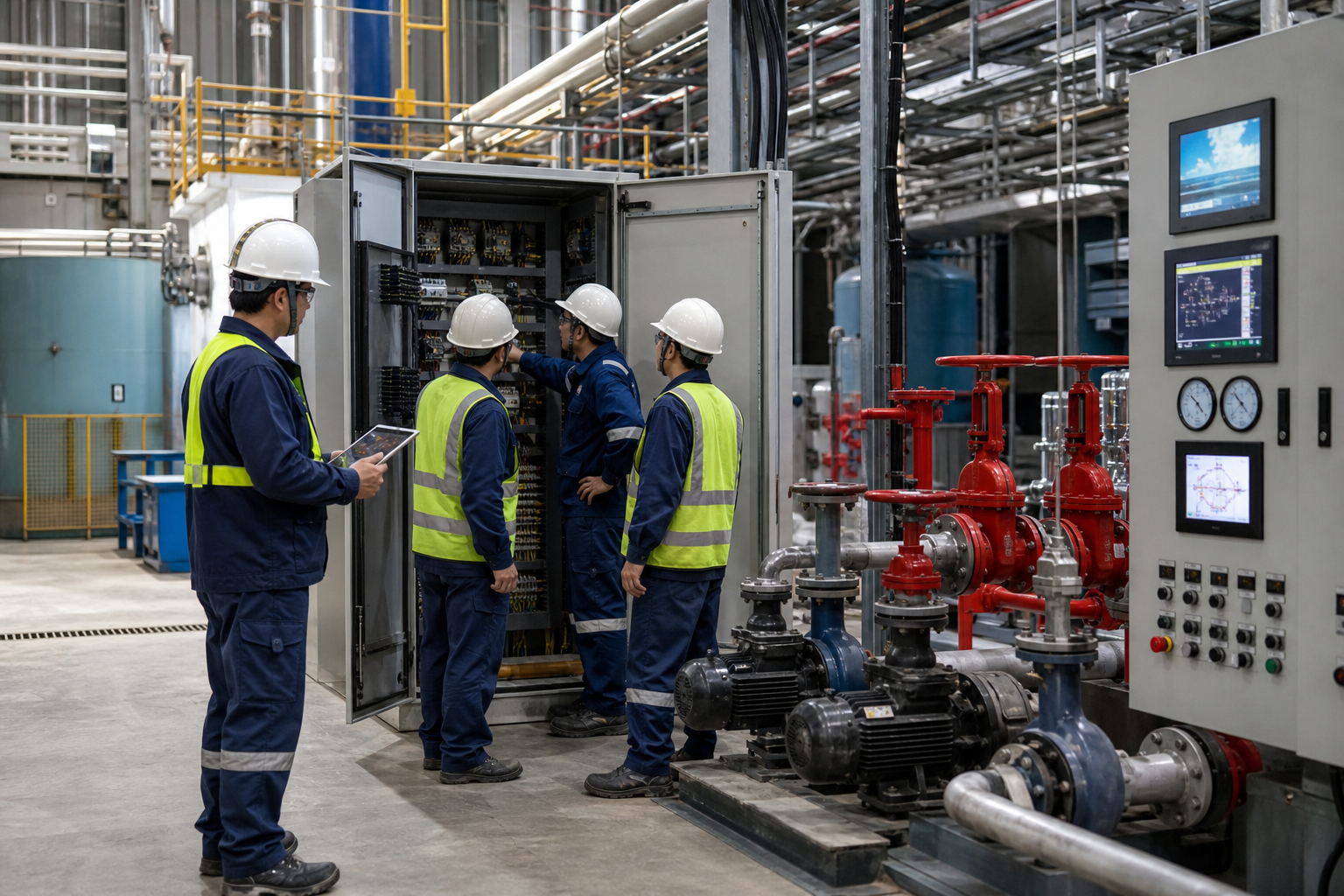
Assume a factory plans to start trial production in early August. If the team discovers in late July that wastewater trial-operation records are incomplete, or the fire pump cannot reach required pressure under real conditions, the project has little room left to fix the issue without affecting production. Systems related to fire safety and environment should therefore be checked through intermediate milestones, not only at final handover.
| Review area | Question before operation |
|---|---|
| Fire safety | Has the system been tested under realistic conditions? Does the final layout match the documents? Are escape routes blocked by machinery or storage? |
| Power and MEP | Have panels, cables, earthing, lightning protection, lighting, ventilation, compressed air, water and drainage been tested? |
| Environment | Are waste-generation points, collection, treatment, connection, trial operation and monitoring responsibilities clear? |
| Operation and maintenance | Does the factory team have manuals, maintenance schedules, spare-parts lists, warranty contacts and emergency procedures? |
How to close the checklist: each item should end in one of three statuses: Pass when records and tests are complete; Conditional pass when the issue does not block operation and has an owner/deadline; or No operational handover when it affects legal compliance, safety, fire safety, environment, main power or trial operation.
A handover checklist is most useful when it helps the owner decide whether the factory is ready to receive, whether it should be received conditionally, or whether certain issues must be fixed before operation. If the checklist is only used as a final tick-box for payment, it does not protect the business.
The checklist below should be used after major systems have been installed and before signing overall handover. It should involve not only the project team, but also factory operations, maintenance, fire safety, environmental staff, finance/asset management and contractor representatives. Each item should have an owner, status, deadline and impact on operation.
| Checklist group | Needed before handover | Risk-management note |
|---|---|---|
| Legal construction records | Permit/conditions, acceptance, completion/as-built, change list | Weak records make future expansion, repair or authority work difficult |
| Quality records | Stage acceptance, material records, equipment records, test reports and certificates | Missing records weaken warranty and defect resolution |
| Fire safety | Documents, system testing, drawings, operating guidance and escape-route plan | Check the system against final layout, not only paper records |
| Environment | Permit/dossier, trial operation, connection, logbooks and waste-management guidance | Must match actual production activity, not only building infrastructure |
| MEP and utilities | Power, water, drainage, compressed air, HVAC/ventilation, lighting, lightning protection, pumps, valves and meters | Load testing or realistic simulation should be included where possible |
| Maintenance and warranty | O&M manuals, maintenance schedule, equipment list, spare parts, warranty contacts and exclusions | Without this, the operation team must improvise during failures |
| Training handover | Operator training, training record, operating checklist and emergency procedures | Handing over the building without handing over operating capability is incomplete |
| Scenario | Commonly missed point | Impact if not closed before go-live |
|---|---|---|
| Machinery moves in before as-built is locked | Machine foundation, power route, piping or escape route changes are not reflected in drawings | Future repair or expansion requires re-survey and creates responsibility disputes |
| Trial run starts before MEP is load-tested | Power, compressed air, ventilation, pumps and drainage are only tested separately | Unstable production, unclear cause between process equipment and building systems |
| Fire-safety handover follows old layout | Final layout adds temporary storage, partitions, racks or offices | Documents and site condition diverge, creating inspection and incident risk |
| Environmental system lacks trial-operation data | Treatment works are not tested near actual load, logbooks are incomplete | Difficult to prove stable treatment when production begins |
Not every defect should block handover. Some minor finishing issues can be accepted conditionally if they do not affect safety, compliance, operation or maintenance. But issues related to fire safety, environmental treatment, main power, structural safety, escape routes, mandatory acceptance records, key as-built drawings or trial-operation evidence should not be treated as small items to fix later.
A practical method is to divide remaining issues into three groups. Group A blocks operation and must be solved before trial run or handover for operation. Group B can be accepted conditionally with deadlines, responsible parties, temporary measures and payment retention if appropriate. Group C covers minor finishing or cosmetic items that do not affect operation but must still be recorded with photos and deadlines.
| Issue group | Example | Treatment |
|---|---|---|
| A – blocks operation | Fire-safety system not tested, unsafe main power, wastewater not connected/treated, blocked escape routes | Do not accept operational handover; resolve before trial run |
| B – conditional handover | Some secondary documents missing, non-critical defects, auxiliary equipment adjustment | Accept conditionally with deadline, responsible party and retained obligation/value |
| C – minor finishing | Touch-up paint, cleaning, minor labels or cosmetic adjustment | Record in punch list with photos and warranty/close-out deadline |
Gova’s role is not to create more paperwork for the owner. The value is to help structure the handover so that legal, technical, fire-safety, environmental and operational requirements are not checked in separate silos. Many late-stage risks appear exactly at the interface between these disciplines.
For factory, warehouse, fit-out or renovation projects, Gova can help review completion documents, compare site condition with drawings, coordinate fire-safety, environmental and MEP checklists, classify remaining defects by operational impact, and propose a close-out route before handover. Engaging Gova at this stage helps the factory enter operation with fewer blind spots.
Related articles: Leasing a ready-built factory in Vietnam | EIA, environmental permit and trial operation | 2026 fire-safety procedure cuts


