

contact@govacons.com.vn

0938 727 179



A factory may be exempt from a construction permit and still not be ready to start building. Three separate questions determine readiness: which exemption applies, what must be sent before commencement, and what documents must exist for construction to proceed. Answering the first does not settle the other two.
The distinction matters when an investor already holds an investment decision, planning documents or an appraisal result. Each establishes something different. Selecting the wrong exemption can lead to the wrong submission, delivery to the wrong authority, or contractor mobilisation before the design and contractual arrangements are ready.
Based on sources reviewed through 26 November 2026. This article examines pre-commencement obligations, not the legal status of a particular project. Its main references are Article 43(2)–(3) and Article 48 of Construction Law 135/2025/QH15; Article 12 and Annex V of Decree 207/2026/ND-CP; and the dossier and delegation provisions of Decree 217/2026/ND-CP. Vietnamese statutory texts remain the authoritative references; the English explanations below describe their application without replacing them. [1] [2] [3]
Asking whether “a factory needs a permit” is too broad if the next step is to find one convenient feature that supports an exemption. A stronger approach identifies the works, their type and grade, the investment route and the location, then checks the grounds in Article 43(2). The chosen ground needs documentary support, not just a project description.
For many business-investment factory projects, point e deserves close examination. It concerns works within a project whose feasibility study, or adjusted feasibility study, has actually been appraised by the specialist construction authority and approved as required. Both appraisal and approval must have occurred. Being subject to appraisal is not the same as having completed it. [1]
Investors should read the title, conclusions, subject matter and scope of the appraisal document. A consultant’s verification report, a design approved internally by the enterprise, or a planning document does not by itself replace the competent specialist authority’s feasibility-study appraisal. Where the project has changed, check which result and approval currently cover the specific works scheduled to start.
Likewise, a factory does not automatically qualify because it sits in an industrial park or has detailed planning. Planning provides part of the development basis; the exemption must still be grounded in law. Appraisal coverage requires consideration of Article 27 of the Law and Article 32 and Annex IV of Decree 217. The listed categories include industrial works of grade II and above, but that fact alone does not establish point-e eligibility for every factory. Actual appraisal and approval remain essential to that ground. [1] [3]
Other grounds are not interchangeable alternatives. Point b concerns works under public-investment projects decided by the particular officeholders and authorities listed in the Law. Point c concerns linear works meeting the specified territorial or planning and route conditions. Having an infrastructure route within a factory development does not convert the entire factory into linear works; individual components must be classified correctly.
Point g includes grade-IV works, but with exclusions concerning functional zones, urban-development areas, rural residential or construction areas identified in the relevant general plans, and areas with architectural-management regulations. It cannot be reduced to “rural grade-IV factories are exempt”. The thresholds of fewer than seven storeys and a total construction floor area of less than 500 square metres relate to the separate-house category in that point, not a general factory exemption.
For repair or alteration under point h, the location of the affected part is only one consideration. The statutory conditions also address unchanged purpose and function, structural safety, fire safety, environmental requirements and infrastructure connections. A production-layout change should not be classified as exempt minor repair simply because the building’s external dimensions stay the same. The actual changes must be checked against the conditions. [1]
Once the exemption ground is established, Article 43(3) determines what must be sent. It does not give all permit-exempt works one identical notification procedure. That distinction affects how much preparation must be completed before equipment and workers arrive on site.
A corresponding dossier does not turn the notice into a fresh permit application. Eligible exempt works do not need to obtain a permit again merely because supporting documents must be sent. The opposite assumption is equally unsafe: exemption does not mean that a single notice is always sufficient. A factory genuinely qualifying under point e falls within the supporting-dossier branch. That work belongs in the preparation programme. [1]
The express exclusions in Article 43(3) cover state-secret works, emergency and urgent works, temporary works, and separate houses of households and individuals. They do not exclude everything listed under point a. An investor cannot take the treatment of temporary works and extend it to every other category sharing that point.
Even temporary works are not exempt from every document-delivery obligation. Where their design is subject to verification, Article 72(2)–(3) of Decree 217 still requires design documents to be sent before construction. Similarly, the household-and-individual separate-house exception cannot be transferred to a factory, or to an organisation’s housing, merely because the building is small. [3]
“Notification only” describes the documents sent under Article 43(3), not permission to build without an approved design, contracts or other applicable conditions. Two investors who both need no permit may have different submission obligations. For either investor, the evidence required to be ready for construction may extend beyond what accompanies the notice.
Overlapping grounds need particular care. A public-investment project might fall within point b while also having an appraised feasibility study of the kind described in point e. The reviewed sources do not establish an official universal priority rule for every overlap. Do not automatically choose the branch with fewer documents, or assert that all appraised projects require the same dossier. Record the potentially applicable grounds and confirm treatment with the competent receiving authority in the province.
From 1 July 2026, Article 48(1) sets out the general commencement conditions: possession of the site handed over in full or in part; a permit where required; approved construction drawings for the relevant part, component or works being commenced; construction contracts with the relevant contractors in line with the programme; and prior written or online notification, subject to the statutory exclusions. [1]
It helps to manage two connected document sets: evidence that construction may lawfully start, and documents that must be submitted. Site-handover records, approved designs and contracts belong in the first set according to the applicable conditions. A document’s absence from the notification attachments does not eliminate the obligation to possess it.

For a new factory in the supporting-dossier branch, Article 57(1) of Decree 217 provides the relevant starting point, with the permit-application form omitted. The remaining categories include one of the lawful land documents specified in Article 55, or the competent authority’s written approval of the location and route alignment, or a land-recovery decision issued by the competent authority under land legislation; the project-approval decision; verification reports where applicable; results of fire-safety and environmental procedures and cultural opinions where legally required; and drawings approved or confirmed in the prescribed manner. This is a framework for checking the corresponding dossier, not a claim that every factory triggers every specialist procedure. [3]
The drawings under Article 57(1)(d) extend beyond a factory floor plan. For the relevant works, they cover the project general layout, positioning, principal architectural plans, elevations and sections, foundations, main structural arrangements and external infrastructure connections. Linear works use the corresponding route-related components. A rendering or a few production-layout drawings cannot substitute for the legally relevant drawing set.
The organisation of the construction also affects the appropriate dossier. Article 58 addresses phased arrangements; Article 59 addresses groups of works or all works in a project. Repairs and alterations require reference to Article 61(2), including land documents, existing-condition drawings and photographs of the works and neighbouring works, and the corresponding design documents. Articles 57–63 should not be added together as if every article were a simultaneous submission requirement. Select the provision that matches the actual construction scope. [3]
Article 56 sets general requirements for permit dossiers, including originals, certified copies or legally valid electronic copies, and relief from resubmitting land documents already available in the national database. Drawing formats and digital signatures must be read with Article 18. When using these rules to assemble a corresponding dossier, check the available database access and actual receiving channel. An ordinary unsigned scan is not automatically acceptable everywhere.
The notice under Article 12 and Annex V of Decree 207 connects the documents to the works, investor, scale, function, contractors and expected programme. Its note refers back to Article 43(3); the form itself does not merge the two branches. Before submission, check that the names of the project and component, design versions and intended commencement date agree across the package. [2]
For a multi-component project, the problem may be valid documents covering the wrong scope rather than missing documents. Approval for one component does not establish readiness for another. Phasing is useful only when the work boundaries, corresponding documentation and commencement conditions for the selected part are clear. It is not a mechanism for starting first and legalising the outstanding documentation afterwards.
Responsibility for this comparison should be assigned before mobilisation. Otherwise, the filing team may assume the designer has checked readiness while the designer assumes the filing team has checked the submission. A shared register of scope, approval status and current versions is an organisational safeguard, not an extra statutory form imposed on investors.
“Send it to the Department of Construction” may be incomplete or wrong for a particular project. Article 43(3) and Article 73(7)(c) of Decree 217 place receipt within the provincial People’s Committee’s delegation and authorisation arrangements. The relevant recipient is the authority currently assigned that function for the location and works concerned. [1] [3]
Article 73 also allocates specialist and territorial responsibilities. The Department of Construction covers, among other fields, light industry and construction materials; the Department of Industry and Trade covers the remaining industrial fields. Other departments and management boards have their corresponding sectors or territories, with scope for provincial adjustment and delegation. The authority that once appraised the project is not necessarily the authority receiving its commencement notice.
Permit-issuing powers under Article 53 must also be distinguished from notification receipt. A provision identifying who issues a permit does not automatically identify who receives notices for exempt works. For an industrial-park or economic-zone project, check both the management board’s assigned territory and the current delegation decision. The project’s industrial-park label alone is insufficient. [3]
The Dak Lak Department of Construction’s guidance published on the Dak Lak Department of Construction website on 13 August 2026 illustrates local implementation of the two notification branches and the roles of local and specialist authorities. It does not establish a nationwide obligation to send the same notice simultaneously to a commune authority, specialist department and management board. Nor can its reference to PDF drawing copies erase other dossier components required by the Law and decrees. [11]
When seeking clarification, provide enough facts: work type and grade, proposed exemption ground, component being commenced, location and existing documents. That separates uncertainty about the recipient from uncertainty about content or file format. Asking and retaining the response is a document-management measure, not a new exemption-certification procedure created by this article.
Article 12 of Decree 207 permits direct, postal or online delivery before commencement. Keep evidence of delivery to the correct authority, together with the attachment list and document versions. A receipt does not certify substantive compliance with all commencement conditions. Equally, a stamp from the wrong office should not be treated as completion merely because something was delivered. [2]

Article 43(2)–(3) took effect on 1 January 2026, alongside Article 71 and Article 95(3)–(5), under Article 94(2). That is not the effective date of the entire Construction Law. Its general effective date, including Article 48, is 1 July 2026. Decrees 207 and 217 also took effect on that date. [1] [2] [3]
For 1 January–30 June 2026, the early-effective exemption and notification provisions must be read together with the commencement conditions then applicable. Article 107(1)(e) of the amended 2014 Construction Law required notification at least three working days before commencement. Article 48 of the new Law and the Annex V form under Decree 207 must not be applied retrospectively to the start of January when assessing an event in the first half of the year. [9]
From 1 July 2026, Article 48 and Article 12 of Decree 207 require notice before commencement, without imposing a universal minimum of three working days. That is not advice to send documents immediately before construction: allow time to correct inconsistencies and resolve questions. Special regimes may have their own period, including the special investment procedure discussed below.
Transition cannot be decided by saying that a project “started last year”. Article 95(1) preserves projects and designs approved before 1 July 2026 without requiring reapproval, while subsequent activities not yet performed follow the new Law. Article 95(3) preserves exemption for works exempt under the old law that had already met commencement conditions before 1 January 2026. It also deals with design changes to previously permitted works now falling within an exemption. Those are distinct situations. [1]
Article 95(4) requires close reading of the conclusion in the appraisal notice for design developed after basic design: the relevant transitional exemption depends on conclusions that the design is eligible for approval and satisfies the old permit conditions. Article 95(5) distinguishes two cases. Works within a project for which a construction permit was issued before 1 January 2026 do not require a permit amendment where the adjusted feasibility study has been appraised by the competent specialist construction authority and the project has been approved as required. Separately, works within a project whose adjusted feasibility study was appraised by that authority under the 2014 Construction Law, and whose project was approved as required, are exempt from a construction permit. The applicable subsection must be checked against the project documents. [1]
At decree level, Article 53 of Decree 207 contains transition rules for work type and grade tied to the investment-decision date, previously received applications and acceptance inspections. Article 76 of Decree 217 distinguishes completed appraisals, pending feasibility-study dossiers and pending appraisals of design developed after basic design. Neither “redo everything” nor “retain everything unchanged” is a safe general conclusion. [2] [3]
The review also checked Consolidated text No. 91/2026/VBHN-NĐ-BXD [10] against Decree 347/2026/ND-CP. Article 74 of Decree 217 was repealed from 15 September 2026, not the entire decree; the checked Articles 57, 61 and 73 were not changed by that repeal. Law 24/2026/QH16 contains changes to Article 88 effective from 1 March 2027, not changes to Articles 43 or 48 to be applied on 26 November 2026. These are findings from the reviewed public sources, not an absolute guarantee against every subsequent update. [4] [5] [8]
Article 48(2) provides a different commencement regime for emergency and urgent works, works under special public-investment projects, and works requiring an early start under competent directions as decided by the Prime Minister: only the site condition in Article 48(1)(a) is required. A commercial factory cannot claim this treatment because its delivery contract is urgent or its investor wants a faster programme. [1]
For special public investment, the relationship between Article 43(3), Article 48(2) and Article 12 of Decree 207 needs care. The category is not listed among Article 43(3)’s express notification exclusions, while the commencement conditions and decree’s general mechanism treat it separately. The reviewed sources do not provide an official explanation resolving that relationship completely. This article therefore does not declare either an unconditional notification exemption or a full pre-commencement dossier obligation by relying on one provision alone. [1] [2]
The special investment procedure is a different regime and must not be confused with special public investment. Article 4(3) of the Construction Law gives the Investment Law priority where their provisions differ. Article 28(3) of Investment Law 143/2025/QH15 requires notification to the local construction-order management authority and the management board, with an economic-technical report whose preparation, appraisal and approval the investor organises, plus the statutory verification report. The ordinary permit-equivalent dossier should not be applied mechanically to this regime. [6]
Article 49(4)(a) of Decree 96/2026/ND-CP requires projects using the special investment procedure with a construction component to notify no later than 30 days before commencement. Article 49(2) also requires an environmental permit before commencement where applicable. Therefore, “all works now only need notice immediately before starting” is too broad. The investment regime must be established before selecting the deadline and document package. [7]
Hypothetical scenario, not an actual project: an enterprise plans to start a new factory component eligible under point e. Assume that the competent specialist construction authority has appraised the feasibility study, the project has been approved, the component falls within that scope, and there is no unresolved transition issue or special investment regime.
The enterprise initially assumes that permit exemption means sending only a commencement notice. On rereading Article 43(3), its preparation team identifies point e as a supporting-dossier case. It is not being asked to apply for a permit again; it omitted a separate preparation obligation from the programme.
The designer also discovers that the intended submission drawings do not match the approved construction-drawing version for the component. Part of the production layout is still under consideration. This hypothetical does not assert that the proposed change necessarily requires a particular new fire-safety or environmental procedure. That depends on the actual change and the relevant legislation, to be assessed by the responsible specialists.
Keeping the original mobilisation date could place workers and equipment on site before the selected construction scope is ready. Waiting time, drawing revisions and contractual rescheduling can affect delivery; their actual impact must be assessed against the contracts and project circumstances.
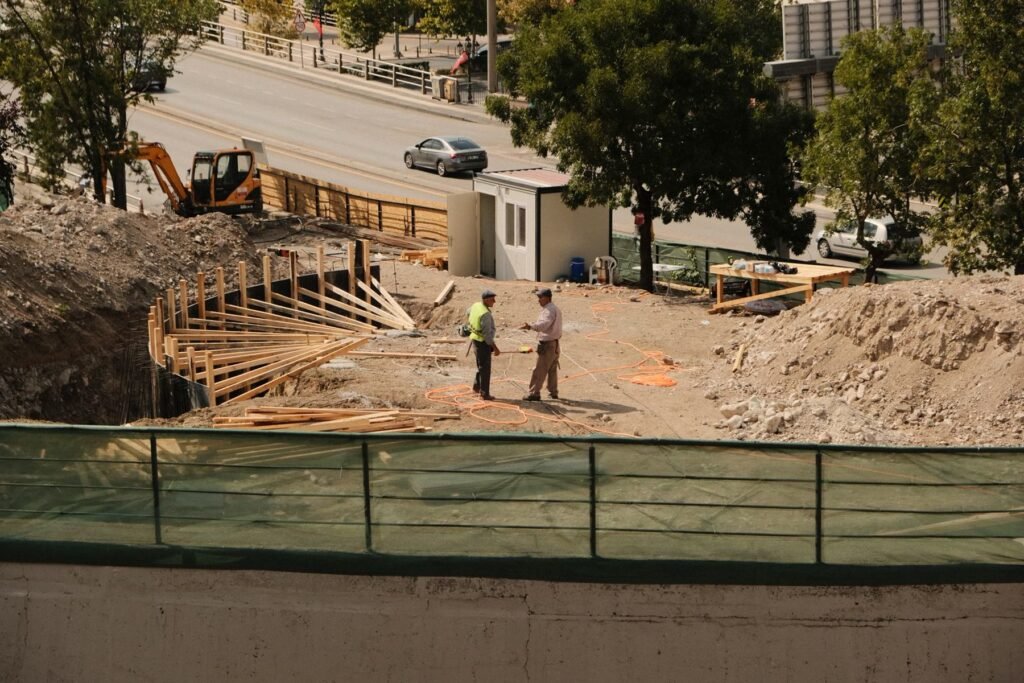
The corrected decision is to fix the component’s scope, align the design versions, check Article 48 conditions and assemble the Article 57 corresponding dossier for this scenario. The investor identifies the recipient under provincial delegation, uses Annex V, sends the package before commencement and retains delivery evidence and the file list. Only work that satisfies the applicable conditions enters the execution programme.
The lesson is not that every factory must submit this exact package. A different exemption, investment method, transitional position or work type may change the notification branch and supporting documents. What transfers across projects is the need to verify the evidence chain before treating the start date as settled.
The person approving mobilisation needs a conclusion that can be checked, not simply an assurance that the works are exempt. Investors, legal advisers, designers and construction teams can organise their review in the sequence below. This is a practical coordination method, not an additional government-issued procedure.
The designer’s role is more than supplying files: it includes clarifying which approved design covers the intended work and whether it still aligns with the exemption evidence and specialist results. The local filing team should clarify the recipient and receiving format, not rewrite statutory conditions. The construction team needs clear boundaries for the work it may undertake rather than assuming that a submitted notice covers every component.
Permit exemption does not remove construction-order oversight. Article 67 of Decree 217 provides for checks on commencement conditions, exemption eligibility, planning compliance and design parameters in the appraised feasibility study. A consistent document set supports both notification and an explanation of why construction is lawful. [3]
Gova can coordinate with investors to define the required scope of consultancy, design, construction, legal-dossier and fire-safety support. That scope must follow the actual project documents. Coordination does not replace decisions by competent authorities or advice from legal counsel. This article provides orientation at the source-review date, not a legal determination for every factory.
For broader context, the related Vietnamese articles discuss Decree 217 and construction permits and pre-commencement legal checks for factories. The narrower decision here remains the same: identify the correct exemption so that the investor knows what must exist, what must be sent and who must receive it before construction begins.
Numbered citations link to the official sources below. Dak Lak guidance is used only as a local example. For an individual project, check the applicable delegation decisions and legislation at the time of implementation.


