

contact@govacons.com.vn

0938 727 179



A factory rarely becomes urgent merely because a building must be erected. The real pressure is the date on which a production line must run, an order must ship, a tenant must receive space, or financing assumptions begin to matter. Once that date has been communicated to customers, suppliers, management or operations, the owner is not simply buying a construction schedule. The owner is protecting a business commitment.
The relevant question is not simply whether an activity is complete. It is the dependency: if this choice moves by a week, which input becomes stale and which part of the contingency is consumed?
A sound option states the conditions under which it remains sound. If those conditions change, the owner should learn early enough to retain the route, adjust scope, resequence work or reset an external commitment.
Project governance should move from reassurance to evidence: issued data, confirmed specifications, checked surveys, formal responses where required and an explicitly assigned responsibility.
More alternatives do not automatically create transparency. Three options without comparison criteria still require guesswork; two options with clear conditions and impacts are normally more useful.
Decision time is not spent only on site. It is affected by whether a decision reaches the right person with sufficient basis before it touches procurement, a filing, or work that is expensive to reverse.
That is why every brief should name the owner of the next action, the response deadline and the acceptance test. Otherwise, “under coordination” can conceal work that no one is empowered to close.

A decision about foundations, fire-safety provisions, power capacity, line layout or contractor selection can feel irreversible. Approve too early and the project may be locked into a wrong basis; wait for every detail and the safe window may disappear. Both risks are credible. “Decide faster” is not useful advice unless it also makes the consequences, evidence and recovery options visible.
Owners also carry an asymmetry of regret. A visible approval that later proves wrong is easy to attribute; the value of a timely approval is less visible because the avoided delay never appears as an incident. Good governance corrects that bias by recording the basis, conditions and alternative considered, so a decision is judged against what was knowable at the time rather than against hindsight.
Uncertainty should be separated into facts that can be obtained, estimates that can be bounded, and choices about commercial exposure. Waiting is justified for the first category when the fact is decisive. It is not a substitute for deciding the third category, such as whether a customer commitment is firm enough to justify an early order or a phased release.
People often delay because a recommendation arrives as a technical conclusion without its commercial consequence. The owner may understand that a transformer size has changed, yet not know whether the effect is a modest allowance, a lost commissioning window, or a decision about future production capacity. A recommendation must translate the interface into business terms without hiding its technical limits.
Consensus can be valuable, but unanimous comfort is not a realistic approval test. Finance, operations, design and construction will naturally weight different losses. The useful question is whether the right people have seen the trade-off, whether the dissenting condition is recorded, and whether the person with decision rights has explicitly accepted the residual risk.
An escalation should arrive before the issue becomes an emergency. The project manager can flag an approaching expiry when supplier validity, a permit submission, a shop-drawing release or access to a work area is at risk. The owner should not first hear of the matter when only a premium-price or delay option remains.
Equally, an owner should be able to decline a recommendation without creating a vacuum. The record can state what additional evidence is required, who will obtain it, and the date on which the decision returns. That protects legitimate challenge while preventing a polite request for more information from quietly becoming an indefinite hold.
Drawings, surveys and procedural registers are essential, but none of them is a decision by itself. An owner needs a concise decision brief that puts alternatives side by side: the effect on the target operating date, the evidence still required, legal and technical implications, cost and risk trade-offs, the latest safe decision date, and the person accountable for the next action. That changes a meeting from a status update into a controlled choice.
A practical brief begins with a single decision sentence, not a background narrative. “Approve a conditional order for equipment common to both layouts” is clearer than “discuss equipment coordination.” It identifies the decision-maker, makes the boundary testable and prevents the meeting from drifting into matters that the technical team can resolve under delegated authority.
The programme page in the brief should show decision timing rather than decorate the report with every activity. Mark the point at which a choice consumes float, the point at which a supplier needs instruction, and the point at which work becomes costly to reopen. This lets a non-specialist see why the question has reached the meeting now.
Use confidence labels carefully. A confirmed utility letter, an issued-for-construction drawing and a supplier estimate are not equal evidence. The brief should say which assumption is verified, which is being relied on temporarily, and what event will invalidate the route. This is more useful than presenting a single precise forecast that implies certainty where none exists.
Cost should be compared as a decision cost, not only as a quotation total. Include likely redesign, protection of completed work, testing, temporary works, financing or lost operating opportunity where material. The estimate need not pretend to be exact; a range with stated exclusions is more honest and allows management to decide whether more pricing work is worthwhile.
The recommendation should include a reversible first move where one exists. For example, the team may reserve a plant footprint, order universally usable components, or hold a contractor slot while critical data is confirmed. Such measures are not free, but they can preserve options more cheaply than committing to a complete solution on incomplete information.
After the meeting, the decision log is the control document. It should identify the approved option, conditions, money or scope limit, owner, expiry date and notification group. A later reader should be able to distinguish a true approval from a working assumption and see immediately what must happen before the project may rely on it.
Not every uncertainty belongs on the owner’s desk. A consultant, designer or main contractor should reconcile technical interfaces, coordinate drawings and test dossier assumptions before escalating them. The owner must retain decisions that define the business: how firm the operating commitment is, the balance between immediate capacity and future expansion, the capital boundary, non-negotiable performance standards, and the level of exposure the business accepts in sales or production planning.
The owner normally sets the hierarchy of objectives: safe and lawful operation, the required production or leasing outcome, capital discipline, quality level and date commitment. The project team then turns that hierarchy into coordinated work. Problems arise when a team is asked to “protect the date” without being told whether it may defer non-critical scope, use contingency, or alter future-expandability provisions.
Delegation works best when it is specific. A design manager may resolve clashes inside an approved performance envelope; a procurement lead may negotiate terms inside an authorised budget; a project director may release work once stated prerequisites are met. None should infer authority to alter process capacity, accept unverified compliance assumptions or commit the business to a different handover promise.
Escalation thresholds should reflect consequence rather than job title alone. A small value variation might need owner attention if it changes a fire compartment, maintenance access or customer acceptance. A larger adjustment might be delegated if it is a like-for-like substitution within approved standards and has no programme or dossier effect. The rule is impact, evidence and reversibility.
Functional representatives need a defined role as well. Operations should validate process needs and commissioning readiness; finance should test funding and exposure; legal or compliance advisers should identify obligations and contractual limits. They advise or approve within their remit, but the project record must still show who integrates those inputs into the decision put to the owner.
Project teams should not escalate raw disagreement. Before escalating, they should close what can be closed: compare drawings, obtain supplier clarification, identify code or authority questions, and set out workable options. Escalation is for a business choice or an unresolved constraint, not a way to transfer routine coordination to the owner.
Once a decision is made, ownership continues. The person accountable for implementation should confirm that the stated conditions are met and report if they move. The approving owner need not re-approve every action, but should be told when the decision has crossed its limit, lost its evidence basis or begun to affect another approved objective.
This is a typical anonymised scenario, not a Gova project. An owner needs a factory ready on a fixed date promised to a customer. The initial design relies on supplier data for equipment loads, utility connections, service height and electrical demand. A revised supplier catalogue then increases the load in one area, changes utility routing and requires a larger electrical cabinet footprint. The issue is not merely a drawing revision.
The first discipline in this situation is to freeze only the affected interfaces, not to label the whole project as stopped. The team can identify which foundations, embeds, routes, rooms and procurement packages depend on the revised data, while continuing independent works. That distinction protects productive work without allowing an obsolete assumption to be built into a costly area.
The supplier clarification should be treated as a project input with a date and a responsible source. Catalogue information, a sales discussion and a signed technical schedule have different reliability. The brief should state which document governs load, dimensions, utilities and access, whether it is compatible with the intended process, and what happens if the supplier changes it again.
One option may be local strengthening and a revised route; another may be a layout change that avoids structural intervention; a third may defer the affected equipment while opening the remainder of the facility. The comparison should include construction access and commissioning consequences, not merely the engineering price. The least expensive drawing change can be the most disruptive route on site.
Procurement terms can create a second decision. If a supplier requires an early commitment, the owner should know which components remain usable across options, what cancellation or variation rights exist, and whether a reservation payment buys real flexibility. Buying early is defensible only when the contractual exposure is visible and the item does not force a premature technical choice.
The project may also need to notify parties outside the design meeting. A landlord, utility provider, insurer, customer or lender may have a condition tied to capacity, access, safety or the operating date. The brief does not need to predict every outcome; it should identify whose confirmation or notice is a prerequisite so that external dependencies do not appear after the internal choice is made.
The corrected route therefore has a clear stop point. If the needed supplier confirmation, authority view or cost boundary is not obtained by the stated date, the contingency option returns to management. This is not pessimism. It turns an uncertain promise into a controlled choice between defined losses while there is still time to protect the core business objective.
Corrected decision: the team neither lets site work continue on obsolete data nor stops everything. It protects the affected scope, reconfirms supplier data, compares strengthening and layout-adjustment routes, checks filing and procurement effects, then gives the owner a brief with a safe decision date. The operating commitment is managed as a constraint to protect, not a slogan.
Investment, land, environmental, construction, fire-safety and operating requirements may be interconnected on an industrial project, yet they do not follow one universal sequence. The practical route depends on location, land status, factory function, scale, production process, environmental impact, fire risk and the filing date. Durable speed comes from identifying the evidence and prerequisites that apply; it is not achieved by skipping mandatory procedures or treating compliance as paperwork to be solved at the end.
Compliance work needs the same interface discipline as design. A change in function, process, capacity or layout can alter the evidence needed for a dossier, a specialist review or an operating condition. The team should identify the question early, preserve the relevant design and process data, and obtain advice appropriate to the project rather than relying on a generic sequence copied from another factory.
Legal and authority-facing matters should not be reported as a simple green or red status. The owner needs to know what has been submitted or confirmed, what remains an interpretation or requested clarification, who owns the next response, and whether the programme is relying on a date outside the project’s control. That distinction prevents an informal discussion from being mistaken for a formal clearance.
Design choices can make later compliance evidence easier or harder to demonstrate. Equipment access, compartmentation, egress, drainage, ventilation, testing points and record drawings are operational features as well as documentation issues. Resolving them late can reopen finishes and reduce time for testing, so they deserve attention before work fronts are released rather than at handover.
Procurement must align with the evidence route. A substituted material or imported item may have different certificates, dimensions, lead times or test requirements. The cheapest available product is not necessarily the quickest usable product if its documents, installation method or acceptance path have not been checked. The decision brief should say what evidence is required before a substitution is authorised.
Construction sequencing also affects compliance and quality. Concealed services, fire stopping, penetrations, grounding, drainage slopes and structural connections may need inspection or records before they are covered. A programme that protects installation time but leaves no time to inspect, test and correct is not genuinely protecting the operating date; it is shifting risk to the last possible stage.
No article can determine the required procedure for a particular project. The applicable route should be checked against the filing date, location, land and investment status, scale, factory function, process, environmental impact and fire risk. The useful governance action is to make that verification an explicit prerequisite, with a named owner and date, rather than an assumption in a programme note.
Backward planning is useful only when it does more than list activities. It identifies decision gates: when function must be frozen for design inputs, when equipment data must be confirmed for procurement, when a dossier must be complete enough to file, and when a specialist contractor or construction method must be selected. Each gate needs a latest safe date. After it, a choice may remain possible, but it consumes contingency, adds cost, or moves the operating date.
Begin with the operational event in enough detail to test readiness. “Open the factory” may mean energisation, trial production, customer inspection, an occupancy milestone, first shipment or a lease handover. Each has different prerequisites. Defining the event prevents the team from declaring success because construction is substantially complete while utilities, testing, training or customer acceptance remain unresolved.
Work backward through commissioning, inspection, access, installation, procurement, design release and information freeze. At each point, identify the decision that enables the next step and the evidence that makes it safe. This produces a chain of decision gates rather than a decorative critical path, and it exposes when two gates compete for the same specialist resource or external response.
A latest safe date is not the same as a desired date. It includes time for review, correction, resubmission, manufacture, delivery, installation, testing and a realistic response to defects. If the project has no time for correction, it has no contingency. Showing this openly lets the owner choose whether to invest in acceleration, reduce scope or revise the operating commitment.
Planning should distinguish activities that can overlap from dependencies that cannot. Design development may proceed while a survey is being completed, but final foundations should not rely on an unverified load. Procurement may reserve capacity while specifications are closed, but a purchase order should not override unresolved interfaces. These distinctions make selective acceleration possible without turning every uncertain item into a commitment.
Each gate should have an early-warning indicator. Examples include supplier data due but not received, a drawing package not issued by its review date, utility correspondence without written confirmation, or an inspection window compressed by rework. Indicators are useful because they prompt action before the gate is missed; a report that only shows missed dates is retrospective accounting, not control.
When a gate moves, reforecast the whole commitment rather than hiding the movement inside one work package. The question is whether the operational event still has adequate contingency after downstream effects, not whether an individual contractor promises recovery. A transparent forecast supports a credible conversation with operations and customers if the project must protect safety, quality or lawful completion over an optimistic date.
A good project partner does not throw a checklist at the owner and ask the owner to choose alone. Its value is to read the project context, separate fixed constraints from variables that can still be optimised, and present decision-ready alternatives. In a light advisory role, Gova can help connect legal work, design, procurement and construction into a lean feasible pathway built on the project’s actual evidence—not a generic programme.
An adviser adds value by making the project’s own evidence usable for a decision. That can include mapping interfaces, testing whether assumptions are supported, identifying questions for designers or specialists, and presenting options in a form that distinguishes fixed obligations from choices. It is not a promise that any route will be approved or that every uncertainty can be removed.
For an owner, the practical test of support is whether the next decision becomes clearer: what is being decided, who has authority, what evidence supports it, what condition must be met, and what happens if the condition fails. A partner should make those elements visible across design, procurement and construction rather than sending separate updates that leave the owner to reconstruct the dependency.
Gova can assist in establishing this cadence against the agreed scope, records and responsibilities of the project team. Depending on the engagement, that may involve coordinating decision materials, tracking conditions, or helping separate issues that require an owner choice from matters that the delivery team should close. Authority remains with the parties named in the contract and applicable process.
The objective is not to create more meetings. It is to use a small number of well-prepared meetings to close decisions, then use routine reporting to verify the conditions under which those decisions were made. Owners should see emerging choices early enough to act; delivery teams should have enough delegated authority to keep ordinary coordination moving between those moments.
At handover, the same discipline continues. The project should confirm what has been tested, which records and warranties are complete, what training or operating limits remain, and which deferred items have a funded owner and date. A partial or phased handover is manageable only when boundaries, safety conditions and responsibility for outstanding work are explicit to the people who will operate the facility.
Good governance does not remove uncertainty from industrial delivery. It makes uncertainty visible at a point where the owner can still choose a proportionate response. That is the difference between a date that exists only on a programme and an operating commitment supported by evidence, delegated action and a clear path for escalation.
On a project tied to an operating date, an owner should separate three matters that are often compressed into “approval”: setting the business objective, choosing an acceptable level of risk, and approving a technical response. A project team can properly handle the last matter within agreed standards, but it should not silently alter production commitments, capital limits, leasing strategy or contractual risk allocation. If these matters are not separated, meetings can spend their time debating drawings while missing the question that matters: what is the project permitted to trade away to protect the start date?
A short decision-rights matrix is often more useful than an elegant organisation chart. It can set thresholds for money, delay, function, safety, dossier implications, quality and customer exposure. Rerouting a service within an approved space may be delegated if it does not affect load, maintenance, fire provisions or procurement. Increasing electrical capacity, changing process equipment, splitting handover or relying on a temporary arrangement should be accepted by someone accountable for the business consequence. Such a matrix is an internal governance tool; it does not replace authority required by contract or applicable rules.
Decision rights matter only with a duty to respond. If an authorised person sees an issue after orders are placed or a work method is mobilised, the project has created a late veto rather than governance. Regular meetings should reserve time for decisions approaching expiry, while urgent matters need a clear escalation route: who gathers evidence, who recommends, who decides, and by when. The purpose is not to force instant answers. It is to prevent silence from becoming an unrecorded decision.
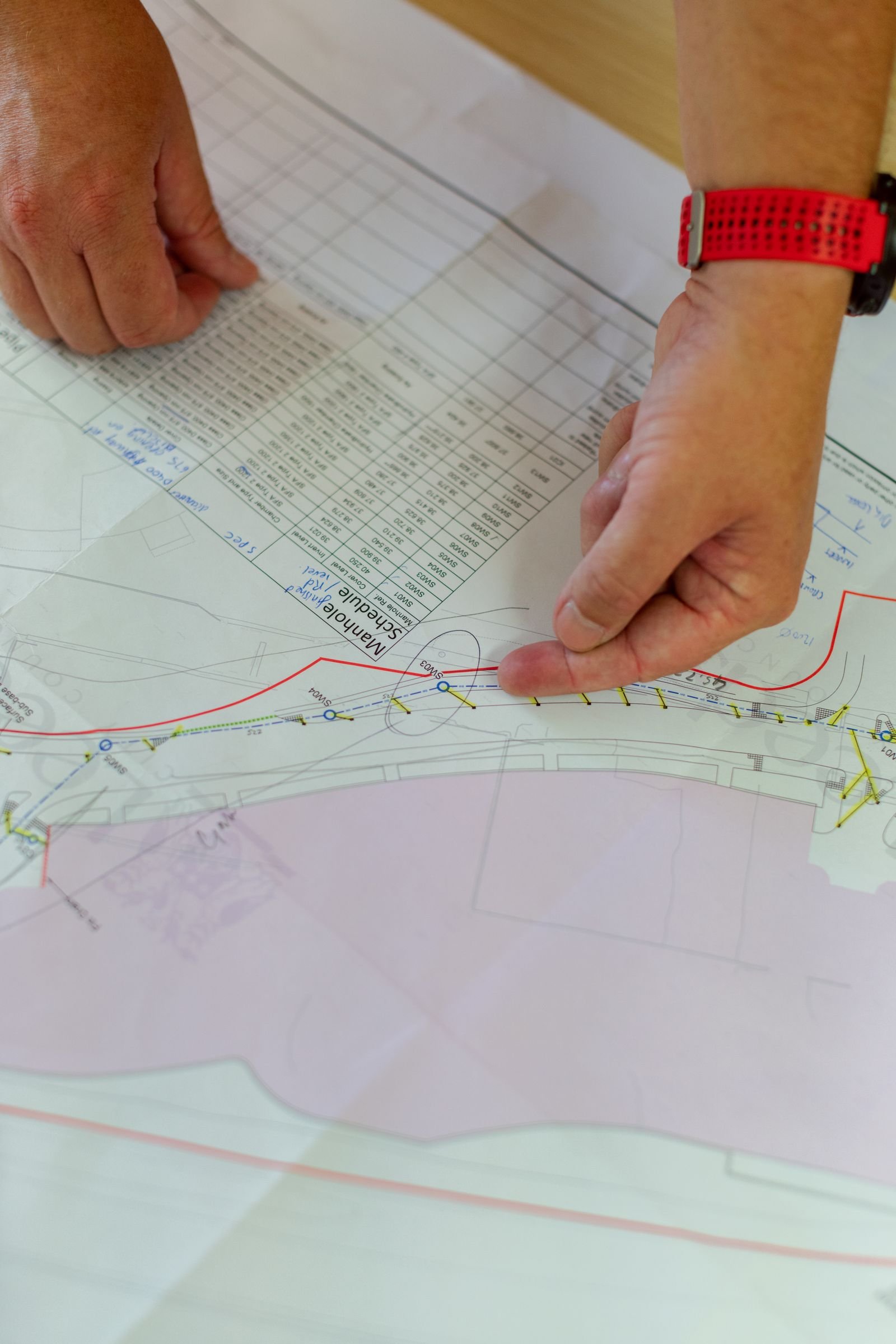
A decision brief is not a long report asking for general comments. It is a structured document that lets someone away from site understand what must be decided, why it is needed now, and what follows if no decision is made. Its opening should state the decision with a verb: approve capacity, select a ground-treatment route, permit a conditional purchase order, or accept a revised handover date. It should then set out the minimum context, genuinely feasible options, the project recommendation and the date on which the choice expires.
The valuable part is not polished formatting but evidence and conditions. Each option should identify confirmed data, remaining assumptions, dependencies, possible cost or time movement, the owner of the next action and the trigger for reconsideration. An early equipment order may be sensible if electrical load, foundation position and supplier-change terms have been checked; the same order is risky if it rests on a catalogue and an unclosed dimension. Clear conditions let a meeting challenge the right issue rather than replay project history.
The meeting practice matters too. Circulate the brief early enough for finance, operations, legal and technical functions to read what concerns them. In the meeting, confirm the question, unresolved conditions and risk being accepted; do not turn it into a redesign workshop. The record should state the choice, delegated scope, conditions, review date and accountable person. If a decision cannot yet be made, record the missing information, its owner and the return date instead of merely saying that the matter remains under coordination.
Legal, design, constructability and procurement dependencies are rarely linear. Assume operations asks for more capacity in one zone for future equipment. The design effect may extend to floor loading, support steel, ventilation, power, drainage and maintenance access. The construction effect may alter finishing sequence or reopen a workface released to another trade. The procurement effect may involve long-lead switchgear, transformers, specialist materials or fire-safety equipment. None automatically defeats the change; together they explain why interfaces should be assessed before promising that the operating date remains intact.
Legal implications should be assessed at the right level. Depending on project type, function, location, scale and the change itself, an adjustment may require review of dossiers, technical agreements, safety conditions or procedures with a competent authority. It is unsafe to say that every revision restarts every procedure, and equally unsafe to assume that a revised drawing is sufficient. A brief should call for advice from the appropriate consultant or authority when needed and distinguish verified facts from preliminary views. This is general guidance; actual submissions should be checked against the filing date, location and project facts.
Constructability is not just whether something can physically be built. A workable solution may require night work, finished-work protection, shutdowns around adjacent operations, extra safety controls or more commissioning time. The difference between tender price and total delivery cost often appears at these interfaces. The owner should ask for enough method information to see access, work areas, acceptance conditions and reinstatement risk, rather than comparing rates alone.

Protecting the operating date can be rational when the value of starting on time exceeds the cost of acceleration and safety, quality and testing conditions remain protected. Acceleration is not a button. It may mean phased release, controlled extra shifts, early orders, temporary configuration or a different contractor, each creating new interfaces to manage. A useful brief says which measure is proposed, which limits cannot be crossed and what contingency will be consumed.
Changing scope can be better when the business need can be achieved in phases without compromising the core objective. Releasing the priority production zone before an ancillary area may protect commissioning, provided escape, safety systems, utilities and operating conditions in the released zone have been properly checked. This is not arbitrary cutting: deferred scope needs a physical boundary, warranty responsibility, budget and its own completion date, so it does not become permanent project debt.
Waiting can be responsible where the decision depends on surveys, equipment data, a dossier response or external infrastructure that cannot credibly be replaced by an assumption. Its cost should be visible: lost float, reduced supplier capacity or price protection, and a possible change to customer commitments. Calling delay “caution” without a plan to obtain the information is not caution. Each wait should identify the question, the data date and the trigger for a contingency route.

In a medium-scale factory project, with identifying details changed, operations requested more load for a proposed equipment cluster after the base design had progressed. The initial response was to order larger electrical equipment immediately to save time. On a procurement view alone, that appeared sensible. The review brief showed that extra load also affected cabinet space, cable routes, ventilation, support steel and the energisation-test sequence; confirmation of the off-site supply was not yet available in writing.
The team presented three routes: retain the original configuration with an early operating limit; conditionally move to higher capacity after critical data was fixed; or move the commissioning date. Management did not select “fastest” in the simple sense. It allowed early purchase only of items usable in both configurations, set a short deadline for supply confirmation, and required a maintenance-access design release. The commissioning plan was also broken into checkable milestones rather than one end-of-quarter date.
This was not a formula guaranteeing success. The project still adjusted part of the finishing sequence and incurred added survey, coordination and contingency costs. Its value was that cost and authority to trade off were visible early: if supply confirmation failed, decision makers already knew what would be affected, who should be informed and which decision returned to the table. The lesson is not always to order early. Commit early only to what has verifiable conditions, and give uncertain elements a clear stop point.
After a decision, risk commonly moves from option selection to control of its conditions. Weekly reporting should revisit assumptions used for approval: whether resources remain available, drawings are issued to the right date, suppliers retain commitments, areas are cleanly released for work, and testing still has time to correct defects. A status colour is useful only with reason and action; a green box is not evidence that a critical condition remains valid.
Owners need not manage every detail, but they should see decisions that are about to narrow future choices. A practical cadence may include weekly critical-path review, periodic cross-functional decisions and escalation when agreed thresholds are crossed. For each significant change, ask which objective is being protected, which assumption has moved, who is affected, and whether today’s choice locks out next week’s option. These questions do not remove uncertainty; they make it manageable.
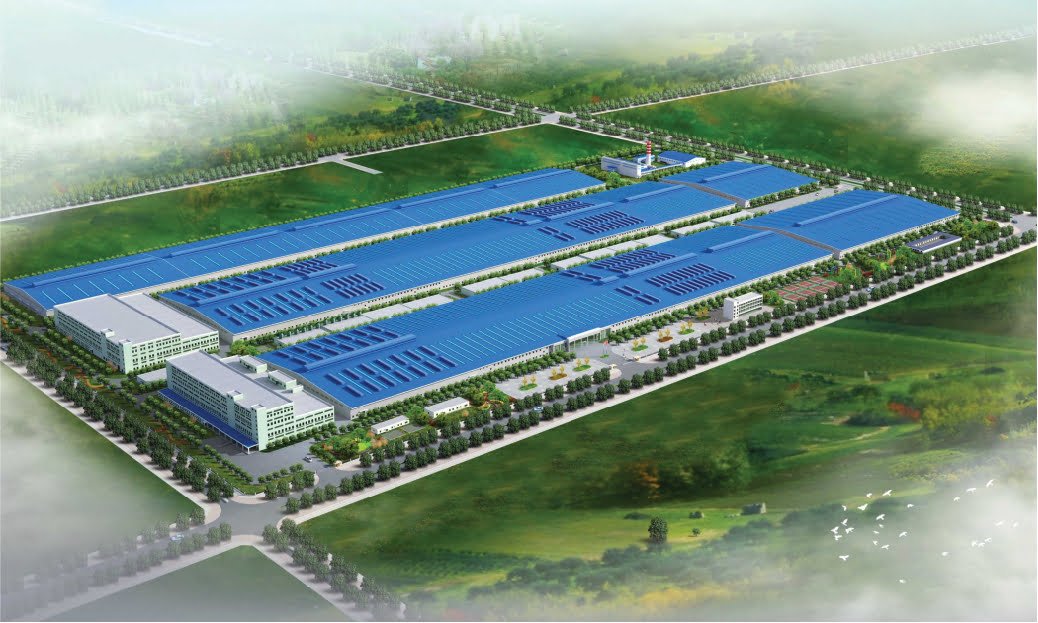
Gova can support owners in organising project information, coordinating design–construction–procurement interfaces and preparing materials for decisions. The support scope should be set against the contract, available records and each party’s responsibility. This article is general orientation and does not replace legal, design, safety or authority confirmation for a particular project.
This article is project-governance guidance. The applicable dossier, sequence and obligations should be checked against the filing date, location, land status, scale, factory function and production process of each project.


